Commercial Window Washing Safety: Residential and Commercial Pressure
Commercial Window Washing Safety: Residential and Commercial Pressure
By Charleston Pressure Washing Editorial Team · Updated 2026-08-25
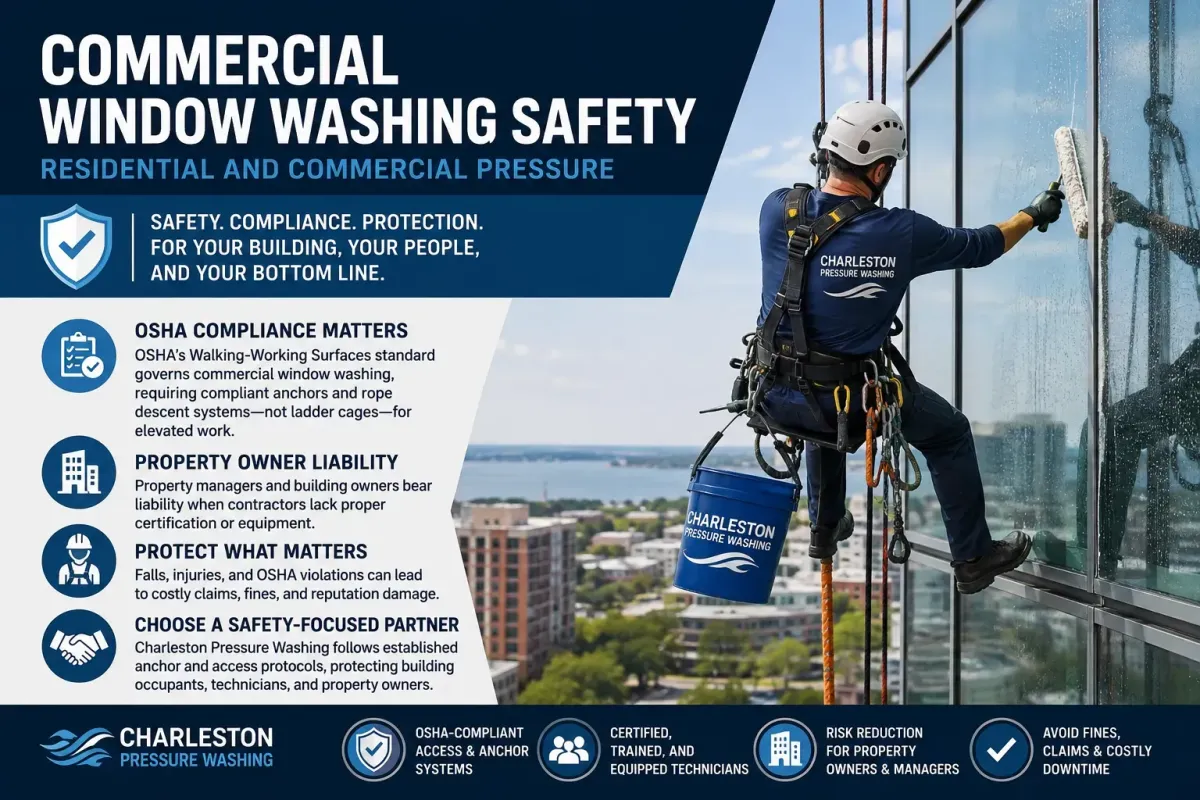
OSHA's Walking-Working Surfaces standard governs commercial window washing, requiring compliant anchors and rope descent systems rather than ladder cages for elevated work. Property managers and building owners bear liability when contractors lack proper certification or equipment. Charleston Pressure Washing follows established anchor and access protocols, protecting building occupants, technicians, and property owners from OSHA violations, injury claims, and costly compliance penalties tied to noncompliant window cleaning practices.
Key Takeaways
OSHA revised Walking-Working Surfaces regulations establish new requirements for window washing anchor and rope descent systems.
Fixed ladder safety systems must replace traditional ladder cages to meet updated OSHA compliance deadlines.
Commercial window washing impacts property maintenance standards and tenant perceptions in major markets like Chicago and Indianapolis.
Proper safety equipment and compliance procedures protect workers performing high-access window cleaning operations on commercial buildings.
Why Do Safety Standards Matter for Your Building?
Safety standards protect building occupants, employees, and the property itself from preventable harm. Professional exterior cleaning programs exist to restore beauty, improve safety, and shield commercial buildings from long-term damage. For facility directors and property owners, that combination of appearance and protection carries real weight in daily operations.
Clean, streak-free glass does more than look presentable. Visibility at entrances and high-traffic commercial zones depends on clear windows. Poor visibility at these points creates genuine safety hazards for tenants, customers, and staff walking through doorways or parking areas. Restoring brightness to exterior glass also strengthens curb appeal, which matters directly to tenant retention and customer perception of a storefront or office building.
What happens when window maintenance gets skipped?
Neglect shows up fast on commercial glass. Streaked windows, hard water stains, and deteriorating frames signal deferred maintenance to anyone walking by, including inspectors, insurers, and prospective tenants. That signal carries consequences beyond appearance: deferred maintenance raises liability exposure and can affect insurance terms for the property owner.
How does exterior cleanliness connect to overall building safety?
Exterior condition and safety performance move together. A property that keeps its glass clean, its frames intact, and its walkways clear demonstrates an active maintenance culture rather than a reactive one. Insurers and risk managers often view visible upkeep as evidence of lower liability risk.
Property managers weighing vendor contracts should treat window condition as part of a broader risk profile, not an isolated cosmetic line item. Consider how neglected glass compounds over time:
Visibility loss at entrances increases slip-and-fall risk for pedestrians.
Deferred maintenance signals invite closer scrutiny from insurers and inspectors.
Curb appeal decline affects tenant confidence and lease renewals.
Building owners who prioritize consistent glass maintenance address both the visible and the financial dimensions of commercial window washing safety at once.

What Do OSHA Anchor Regulations Require?
OSHA's Walking-Working Surfaces standard sets firm structural and procedural rules for anchors and rope descent systems used in window washing. Property managers who overlook these requirements expose their buildings to citations, contractor liability disputes, and — in the worst cases — catastrophic equipment failure. The regulations reach far beyond the widely discussed fixed-ladder deadlines, affecting nearly every building owner who contracts exterior glass cleaning.
Anchorage is the foundation of the rule. Roof anchors supporting window washing equipment must be a permanent part of the building structure. They cannot be temporary fixtures bolted on for a single job. Each anchor must also be sound and rigid, built to carry real working loads without flexing or failing under stress.
How Much Weight Must an Anchor Support?
Minimum load requirements for anchorage points are not left to guesswork. OSHA codified these figures into Appendix C of its final rule, giving building owners a defined engineering benchmark. Any contractor performing commercial window washing safety work should be able to confirm that anchors meet this documented standard before equipment goes into use.
Where Are the Specific Anchorage Rules Located?
Detailed anchorage requirements sit in Section I, paragraph (c)(10), of OSHA's regulatory framework. This subsection lays out the technical specifications inspectors and engineers reference when verifying compliance. Facility directors reviewing vendor documentation should expect contractors to cite this exact provision.
Key structural obligations for building owners include:
Permanence: Anchors must be fixed, integral components of the structure, not removable attachments.
Rigidity: Each anchor point must resist bending or shifting under load.
Load capacity: Anchors must meet the minimum thresholds established in Appendix C.
Documented location: Anchorage placement must align with Section I, paragraph (c)(10) specifications.
Building owners who verify these four elements before authorizing rooftop access reduce exposure to compliance failures and equipment-related incidents significantly.

Who Enforces Compliance and What Does It Mean?
Federal statute, formal standards, and binding regulations establish the rules governing exterior maintenance work at height, not informal industry custom. Property managers and safety compliance officers cannot rely on a contractor's word alone. The framework exists on paper, in enforceable language, and carries real consequences for buildings that fall short.
For commercial property managers in Charleston, West Virginia, this distinction matters more than it might seem. Commercial window washing safety isn't a marketing phrase invented by service providers. It reflects a documented regulatory structure that applies to buildings regardless of size or location.
Does location affect which safety rules apply?
Federal standards apply broadly across regions, but proximity to a contractor still shapes accountability. Charleston Pressure Washing operates from Charleston, West Virginia, placing the company within reach of the same regional commercial buildings subject to these federal safety expectations. Local presence means faster response times and firsthand familiarity with area building types.
What signals show a contractor takes compliance seriously?
Documentation matters, but so does visible practice. Buildings maintained on a consistent schedule tend to score better with reviewers assessing vendor safety records. A few indicators worth checking:
Maintenance frequency — regularly refreshed exteriors reflect an active maintenance program, one factor reviewers weigh when evaluating a vendor's track record
Written safety documentation tied to statute and formal standards, not verbal assurances
Consistency across service visits, rather than one-time cleanups before inspections
Facility directors reviewing vendor contracts should ask contractors to explain, in plain terms, how their practices map to established regulatory language. A contractor unable to answer clearly presents a liability risk worth flagging before any agreement gets signed.

What Belongs in a Written Window Washing Program?
A written window washing program establishes clear requirements and procedures that protect both employees and contractors performing the work. Property managers and facility directors in Charleston, WV rely on this documentation to set expectations before a contractor ever touches a building's exterior. Without it, liability exposure grows quietly with every uninspected anchor point and undocumented procedure.
Strong programs cover more than rope descent and anchorage details. Commercial window washing safety documentation should also define how contractors handle related exterior components. A fragmented approach to maintenance creates its own risks. Screens, for example, often get overlooked until torn mesh or loose frames turn into a bigger liability during storm season.
Does a maintenance program need to cover more than glass?
Yes. A comprehensive exterior maintenance plan extends beyond glass to related components like screens, catching small damage before it escalates. Addressing minor tears or worn frames early prevents larger repair costs and reduces safety hazards tied to deferred maintenance.
What should a vendor contract document?
Vendor contracts should reference a documented service scope, not vague promises. Charleston Pressure Washing provides fresh screen reskinning for damaged, worn, or weathered window screens, restoring airflow and a clean finished appearance. Facility directors can point to this kind of specific, documented standard when comparing vendor proposals.
A written program should include:
Defined procedures for anchor inspection and equipment use
Contractor responsibilities alongside employee protections
Scope language covering glass, frames, and screens together
Preventive repair standards that extend component life before full replacement
Preventive work, like extending screen life ahead of replacement, reflects the proactive posture a safety-conscious program demands. Documentation turns that posture into an enforceable standard rather than a verbal assurance.
How Do You Vet a Compliant Contractor?
Vetting starts with scope, not price. Property managers should confirm a contractor's written scope of work explicitly addresses safety and protection, not appearance alone. A proposal that promises shine but says nothing about protective outcomes signals an incomplete vendor relationship.
Full-service scope matters more than it seems. Contractors who maintain coverage from glass to screens demonstrate the kind of thorough care commercial properties require. That range suggests a provider treats exterior maintenance as a system, not a single task performed in isolation.
What baseline performance should a contractor guarantee?
Streak-free, film-free glass is the minimum bar. A qualified provider's process should visibly remove film, dirt, and streaking as a standard result, every visit, not an occasional bonus. If a contractor cannot describe that outcome plainly, treat it as a red flag.
Can local providers prove their safety practices?
Yes. Property managers based in Charleston, WV can request documentation of safety practices directly from providers operating in the same service area. Proximity makes verification easier and follow-up faster.
Before signing a contract, property managers should confirm:
The scope explicitly covers safety and long-term protection, not just cosmetic results
Glass, frames, and screens all fall within stated service coverage
The provider operates locally and can produce safety documentation on request
Commercial window washing safety ultimately depends on scope, documentation, and local accountability working together.
FAQ
What safety standard governs commercial window washing?
OSHA's Walking-Working Surfaces standard governs commercial window washing, requiring compliant anchors and rope descent systems instead of ladder cages for elevated work.
Who is liable if a window washing contractor lacks proper certification?
Property managers and building owners bear liability when contractors lack proper certification or equipment, exposing them to OSHA violations, injury claims, and compliance penalties.
Does Charleston Pressure Washing follow OSHA-compliant protocols?
Charleston Pressure Washing follows established anchor and access protocols, protecting building occupants, technicians, and property owners from noncompliant window cleaning practices.
Conclusion
In closing, commercial window washing safety standards represent a non-negotiable foundation for protecting both personnel and property assets. Adherence to established protocols—encompassing equipment certification, fall protection systems, and comprehensive training—directly mitigates liability exposure while ensuring consistent, professional results. Organizations that prioritize these standards demonstrate operational excellence. Commitment to stakeholder protection, establishing the reliability and trustworthiness essential for sustained business relationships.
